
American Universalism
The Forgotten Christian Roots of the Nation

One of the oft-neglected aspects of America’s early history is the extent to which there was significant support from the Founding Fathers (and the broader Founding generation) for the theology of Christian universalism.
And, lest there be any confusion, it must be kept in mind that the American Founders nonetheless remained politically committed to national particularism (i.e., “We the People” and “our Posterity” were never universal categories). Yet their emphasis on “liberty and justice for all” and the fact that “all men are created equal”—while these principles do not entail that all humanity is able or welcome to partake of the American nation in particular—does help to explain why more than a few of the early American leaders believed that God ultimately ensures the salvation of all, in the glorious telos of history.
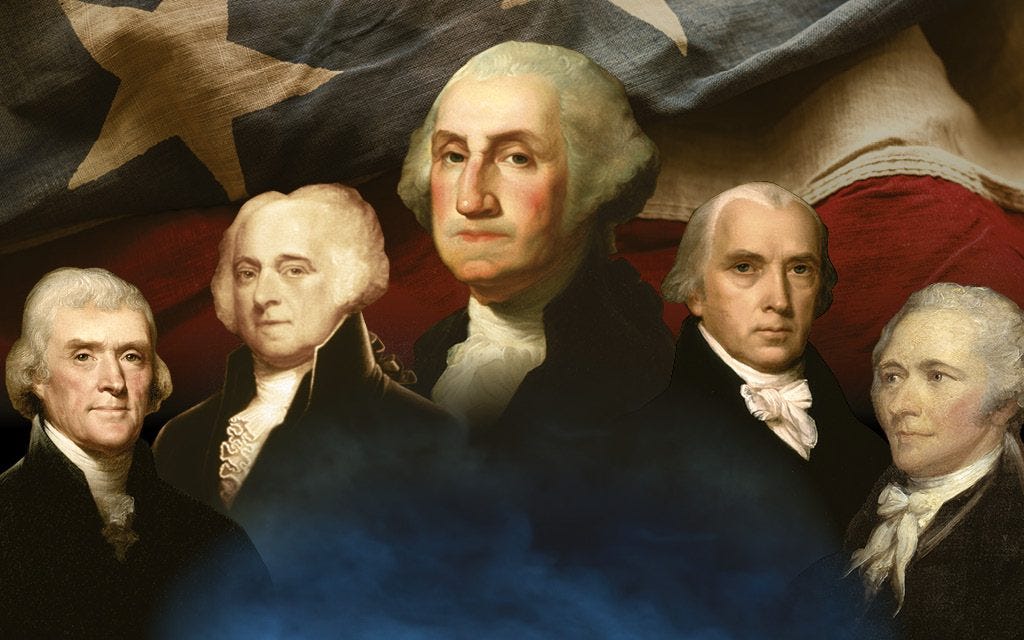
To cite a few illustrative examples…
No less prominent a figure than General George Washington himself appointed a known universalist minister, John Murray, in 1775, to the position of chaplain in the Continental Army.1
Benjamin Rush, signer of the Declaration of Independence, and Pennsylvania delegate to the Continental Congress, explains his embrace of Christian universalism at nearly the same time as his embrace of the American Revolution:
I then read for the first time Fletcher’s controversy with the Calvinists in favor of the Universality of the atonement. This prepared my mind to admit the doctrine of Universal salvation, which was then preached in our city by the Revd. Mr. [Elhanan] Winchester. It embraced and reconciled my ancient Calvinistical, and my newly adopted Arminian principles. From that time I have never doubted upon the subject of the salvation of all men. My conviction of the truth of this doctrine was derived from reading the works of Stonehouse, Seigvolk, White, Chauncey, and Winchester, and afterwards from an attentive perusal of the Scriptures. I always admitted with each of those authors future punishment, and of long, long duration. […] My only hope of salvation is in the infinite transcendent love of God manifested to the world by the death of his Son upon the Cross. Nothing but his blood will wash away my sins. I rely exclusively upon it.2
And, to provide yet another notable instance, Jonathan Mayhew, the man who coined the revolutionary slogan “no taxation without representation,” was also an outspoken Christian universalist.3
Much conjecture could be employed to surmise why it is that the doctrine of universal salvation took root in America (with the Trinitarian universalist denomination, the Universalist General Convention, even becoming, for a time, one of the largest denominations in the U.S.) in a way that it had not practically anywhere else—perhaps it has something to do with the notion of endless conscious torment being a form of ‘tyranny’ lacking the ‘consent of the governed,’ or the understanding that universalism is the spiritual and soteriological corollary of the doctrine of ‘liberty and justice for all.’
But, whatever the case, one thing is clear: Christian universalism is an important part of America’s historical heritage—not only from the Founding era, but even as represented by later figures such as Abraham Lincoln4—and thus merits serious study and appreciation as such.
Boller, Paul (1963). George Washington and Religion. Dallas, TX: Southern Methodist University Press.
Rush, Benjamin (c. 1813), Travels Through Life.
Parry, Robin (2019), A Larger Hope? Vol 2. Universal Salvation from The Reformation to the Nineteenth Century, p. 137.
Noll, Mark A. (1992). “The Puzzling Faith of Abraham Lincoln”.